


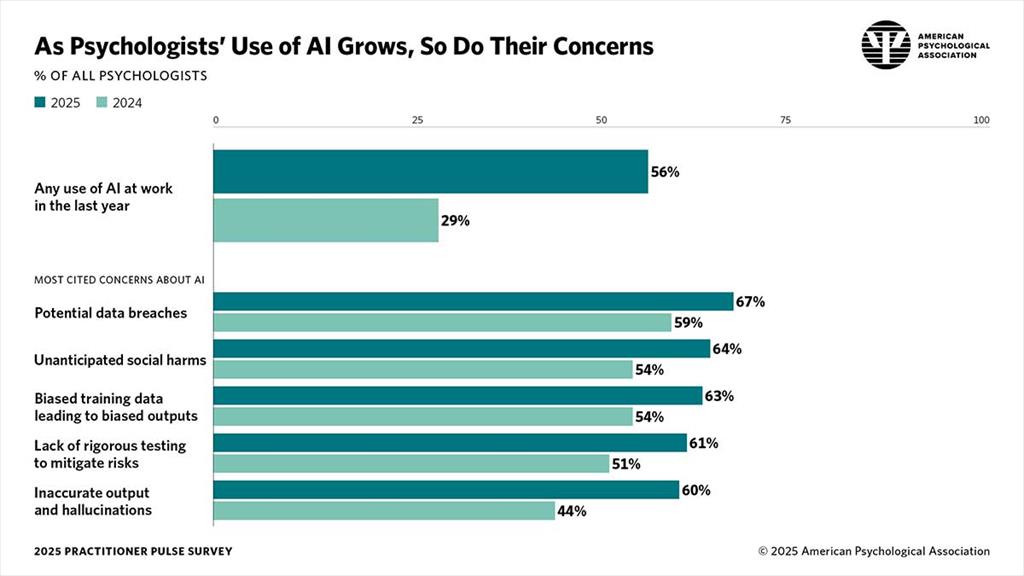
Psychologists are rapidly adopting artificial intelligence (AI) tools in their practices, but their concerns about how the technology may affect their patients and society are also rising, according to the 2025 Practitioner Pulse Survey by APA and its companion organization, APA Services Inc.
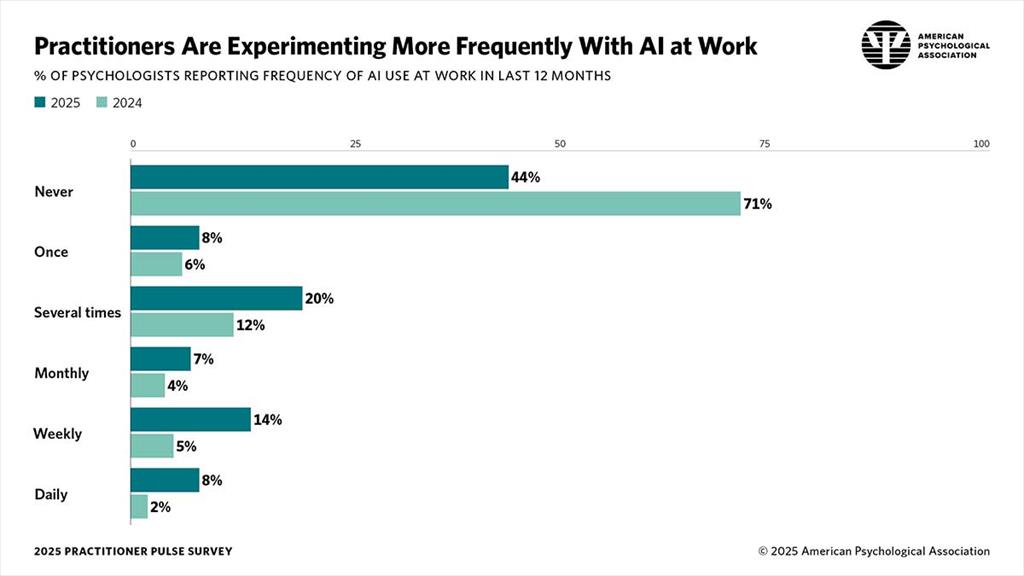
Though few psychologists use AI for clinical assistance, these tools may become an increasingly important part of routine administrative work, such as research and writing, as more experiment with AI. In the past year, the number of psychologists who reported that they had never used AI to assist with their practices fell dramatically from 71% in 2024 to 44% in 2025. And close to three in 10 respondents (29%) said they use AI on at least a monthly basis—more than twice as many who said the same in 2024 (11%).
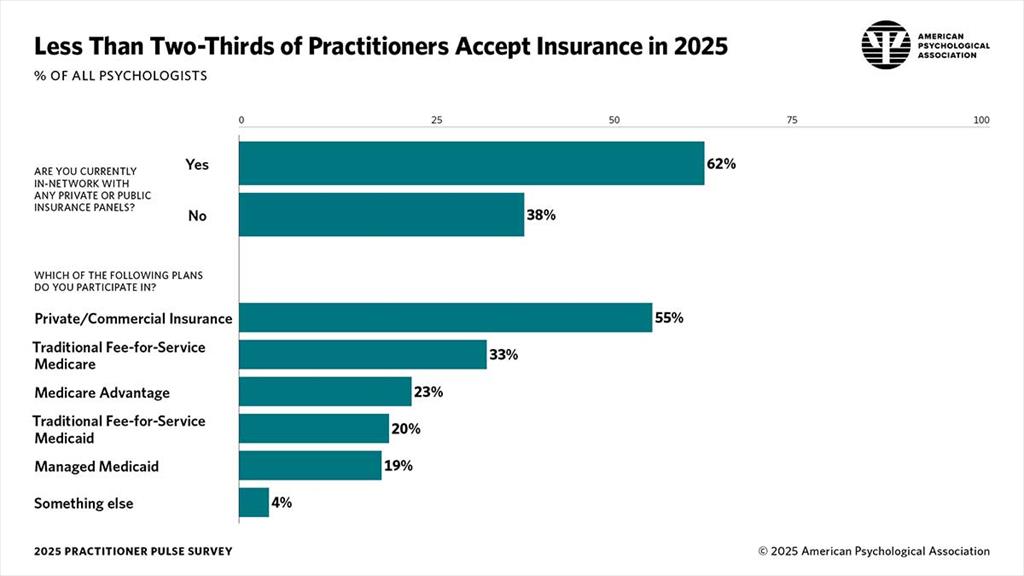
Despite the growing use of new technologies, psychologists continue to struggle to overcome administrative burdens including insurance requirements and demands for treatment. Fewer than two-thirds of psychologists (62%) said that they accept some form of insurance, and even fewer accept public insurance plans like traditional fee-for-service Medicare (33%) and traditional fee-for-service Medicaid (20%).
And while psychologists’ stress levels and work-life balance have improved since the onset of the Covid-19 pandemic, this does not necessarily indicate the mental health crisis has resolved. Nearly half of all practitioners saw an increase in the severity of their clients’ symptoms (45%) and said that they do not have openings for new patients (46%).
More information
- Methodology (PDF, 255KB)opens in new window
- Survey questions (PDF, 190KB)opens in new window
- Topline data tables (PDF, 550KB)opens in new window
- Psychologists increase uptake of AI tools, but cautions persist
- Among psychologists, AI use is up, but so are concerns
- Guidance for the evaluation of AI scribes
Practice Update

Growing concerns about data breaches, bias in AI
As more psychologists turn to AI for routine administrative tasks, they are also raising concerns about risks such as data breaches, biases in the inputs and outputs, and overall harm to society.
In 2024, a majority of practitioners (71%) said they had never used AI tools to assist with their work. One year later, the percentage of psychologists who had never used AI tools has dramatically decreased to 44%. Most practitioners reported in 2025 that they have used AI at work at least once, and the percentage who reported using AI tools at work on at least a monthly basis had risen to 29%, up from 11% in 2024. Close to one in 10 (8%) reported using AI tools daily over the past 12 months.
Along with this growth in usage, potential concerns with AI increased since 2024 as psychologists became more familiar with the technology. In 2024, more than one in five practitioners (23%) said they did not know what the biggest concerns would be with using AI tools in psychology—but that percentage fell to nearly one in 10 (8%) in 2025. The most commonly cited concerns were potential data breaches (67%), unanticipated social harms (64%), biased input and output (63%), lack of rigorous testing (61%), and inaccurate outputs (60%).
Little change in insurance participation since 2024
Practitioners continue to report administrative and financial barriers that make it difficult to participate in insurance networks, as more than a third of psychologists (38%) reported that they did not accept any form of health insurance. Among psychologists who did accept a form of insurance, 10% said they had stopped participating in a private or commercial insurance panel within the past year.
For practitioners who did not accept insurance, or who stopped participating in some form of public or private insurance panels in the past year, financial issues remained a key barrier. The most common barriers psychologists cited to accepting insurance plans were insufficient reimbursement amounts (75%), administrative issues with insurance payers (57%), and concerns about payment reliability (43%). More than a third (38%) also cited denial of coverage for services they deem necessary and appropriate for their patients.
Nearly half of psychologists still have no capacity for new clients
While practitioners’ workloads appear to be improving since a spike in demand in the early years of the Covid-19 pandemic, about half (46%) of practitioners reported having no openings for new patients and 40% currently have a waitlist for new clients. A similar percentage (45%) reported an increase in symptom severity among patients. Some practice patterns were marked by increases followed by decreases, such as increases in treatment course length, inability to meet demand, and burnout.
The majority of psychologists said that they had maintained their workload since last year; 59% said they were working the same amount as they did 12 months ago and 56% said they were treating the same number of clients. Only one in five psychologists said they were working more (20%) or less (21%) than they did 12 months ago.
However, stabilizing practice patterns do not necessarily indicate the mental health crisis has resolved; limited capacity for new patients, increases in symptom severity, and increases in length of treatment course restrict psychologists’ ability to fully meet needs for health services. Among psychologists who do not have a waitlist, 22% said they do not have the capacity to manage a waitlist and 9% said that too many people were requesting services.
Methodology
The 2025 Practitioner Pulse Survey is the most recent survey cycle of a series of annual, online surveys conducted by APA that explores psychologists’ practice patterns. Contact information for the 2025 survey was drawn from APA membership data as well as state licensing board data and used to create a probability-based sample. Of the 30,000 survey invitations sent via email, 26,502 were received, and 1,742 respondents completed the survey for a completion rate of 6.6%. Eligibility criteria included all the following: having a doctoral degree, having a psychologist license, actively working, and treating patients.
Previous reports
For reports and data on previous cycles of this survey:
American Psychological Association. (2020). 2020 Covid-19 Telehealth Practitioner Survey. https://www.apa.org/workforce/publications/response-coronavirus
American Psychological Association. (2021). Worsening mental health crisis pressures psychologist workforce: 2021 Covid-19 Practitioner survey. https://www.apa.org/pubs/reports/practitioner/covid-19-2021
American Psychological Association. (2022). Psychologists struggle to meet demand amid mental health crisis: 2022 Covid-19 Practitioner Impact Survey. https://www.apa.org/pubs/reports/practitioner/2022-covid-psychologist-workload
American Psychological Association. (2023). Psychologists reaching their limits as patients present with worsening symptoms year after year: 2023 Practitioner Pulse Survey. https://www.apa.org/pubs/reports/practitioner/2023-psychologist-reach-limits
American Psychological Association. (2024). Barriers to care in a changing practice environment: 2024 Practitioner Pulse Survey. https://www.apa.org/pubs/reports/practitioner/2024